


Assessment Insight
LEH Assessment
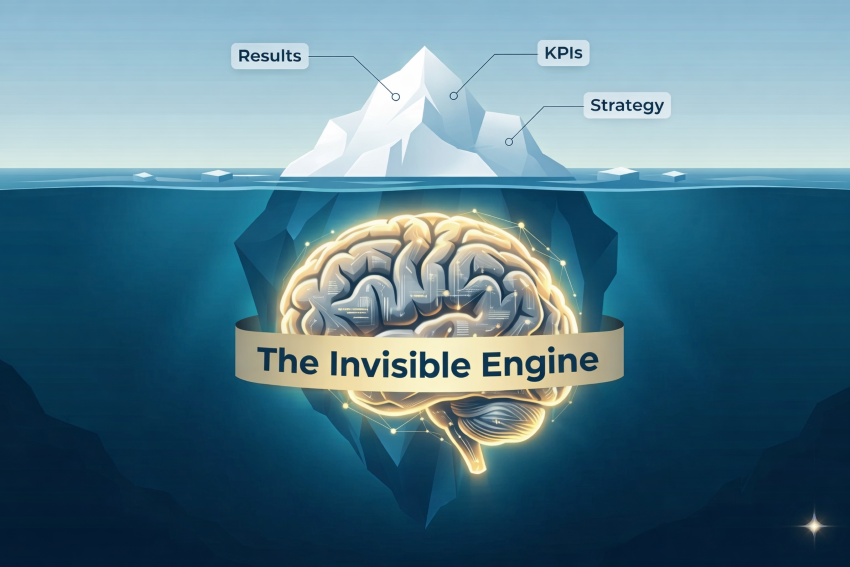
The Science of the LEH Assessment:
Precision Diagnostics for Executive Performance
Most executive assessments tell you who you are. The Leadership Emotional Health (LEH) Assessment tells you how you lead—specifically, how your internal biological and psychological mechanics respond under the unique pressures of high-stakes leadership.
1. The Neurobiology of Executive Function
The core of the LEH is rooted in Neuro-Regulation. In a crisis, the brain’s limbic system (the amygdala) often triggers a "Reactive Spiral" before the prefrontal cortex—the center for strategy and logic—can fully engage. This is often referred to as an "Amygdala Hijack."
The Diagnostic: The LEH measures your specific "latency period"—the gap between a stress trigger and your ability to re-engage sound judgment.
The Outcome: By understanding your biological baseline, you can move from instinctive reaction to deliberate, authoritative action.
2. Managing Cognitive Load & Decision Fatigue
High-level decision-making is a finite biological resource. Science shows that as "Cognitive Load" increases, leaders naturally succumb to Strategic Drift—making choices based on ease rather than impact.
Scientific Pillar Leadership Application
Cognitive Load Theory Preserving mental energy for the 20% of decisions that drive 80% of results.
Emotional Intelligence (EI) Mastering self-regulation to maintain team trust and relational clarity.
3. Systems Thinking: The "Pivot Point" Strategy
The LEH Assessment utilizes Systems Thinking to identify high-leverage "Pivot Points." Instead of attempting to overhaul your entire leadership style, the data points us to the specific internal habits that, when shifted, yield the highest return on investment for your organizational and overall health.
Take the First Step Toward Mastery
Stop guessing and start measuring. Secure your LEH Assessment today to receive your comprehensive data profile and custom development roadmap.
Assessments are hosted within our secure P.A.W. Learning Portal to ensure data privacy and a personalized development roadmap.
The Pivot Assessment

The Pivot Assessment:
Precision Behavioral Agility
Mastering the shift from Innate Instinct to Intentional Impact.
Most leadership failures aren't caused by a lack of skill, but by an application gap—using the wrong behavioral tool for a specific situational challenge. The Pivot Assessment is a diagnostic framework designed to identify your behavioral "baseline" and provide the neurological blueprint for pivoting when the stakes change.
The Six Core Competencies
The assessment measures your proficiency across 60 distinct leadership behaviors, categorized into six high-impact characteristics:
Achieve: The drive for results, execution, and high-performance standards.
Bond: The ability to build deep, psychological safety and trust.
Guide: Providing clarity, direction, and mentorship.
Unite: Fostering collaboration and horizontal alignment across teams.
Excite: Inspiring energy, passion, and a shared sense of purpose.
Champion: Advocating for change, innovation, and the growth of others.
The Methodology: Innate vs. Intentional
Phase 1: The Behavioral DNA (Innate Baseline)
The assessment first captures your Innate Behaviors—the actions you take most naturally. These are the behaviors hardwired into your "behavioral DNA" and muscle memory. By understanding your innate percentage across the six characteristics, you gain clarity on your default leadership style and where you are most comfortable operating.
Phase 2: The Strategic Pivot (Applied Coaching)
True leadership excellence requires the ability to move beyond your default. Pivoting is the intentional act of selecting behaviors that the context demands, even if they aren't your innate first choice.
Through integrated coaching, we focus on the "It"—the specific challenge, conflict, or transition you are facing. We identify the gap between your innate response and the required response, allowing you to:
Identify the specific situation requiring a shift.
Select the intentional behaviors needed to succeed.
Execute with precision through planned action.
Reflect and refine to widen your leadership acumen.
The Result: A measurable, behavior-based expansion of your leadership competency. You stop leading by accident and start leading by design.
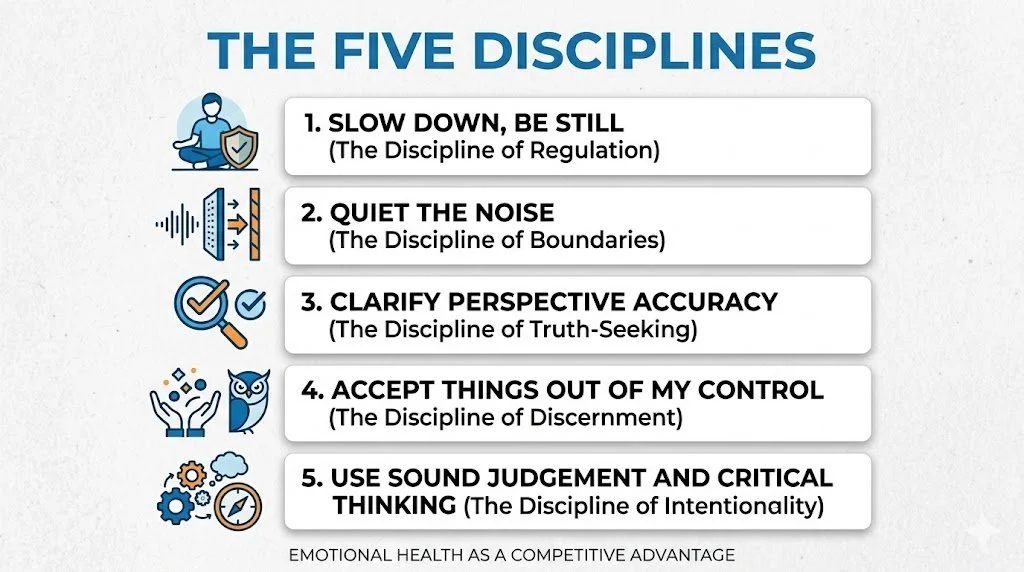
The Five Disciplines
The Five Disciplines of Executive Excellence
The Operational Framework for High-Stakes Leadership.
Leadership is not a state of being; it is a set of practiced behaviors. The Five Disciplines provide a rigorous framework for leaders to navigate complexity, manage cognitive load, and maintain strategic clarity. By mastering these five operational pillars, executives move from reactive firefighting to intentional, high-impact stewardship.
The Core Disciplines
Slow Down: The discipline of deliberate pausing. Before execution comes the essential act of decelerating to ensure alignment with long-term strategy rather than short-term impulse.
Quiet Noise: The ability to filter the essential from the trivial. In an age of information saturation, this discipline focuses on protecting mental bandwidth for the decisions that matter most.
Perspective: Cultivating a multi-lens view of every challenge. This involves zooming out to see the systemic impact and zooming in to understand the human element.
Control: Mastering self-regulation and emotional intelligence. This discipline is the bedrock of executive presence, ensuring the leader remains the "steady hand" in the room.
Judgment: The ultimate culmination of the previous four. It is the ability to make high-velocity, high-quality decisions based on filtered data, controlled emotions, and clear perspective.
From Theory to Application
The Five Disciplines are not abstract concepts; they are measurable practices woven into our coaching sessions. We utilize real-world scenarios to stress-test your mastery of each discipline, moving them from intellectual understanding to muscle memory.
When a leader masters these disciplines, they create an environment of "Flow" within their organization—where clarity replaces confusion, and results follow intention.